Fritz Paul Zimmer, Sculptor

Learn about the Sculptor Fritz Paul Zimmer who created many works around Decatur, including Agnes Scott College.
By Marissa Howard, Programs and Membership Coordinator
Last month, Melissa Carlson, Executive Director, and I led an Architecture walking tour of Agnes Scott’s Campus for a visiting group of higher education individuals.
While waiting for the group, I was enjoying looking up at Leitia Evans Dining Hall. Dedicated in 1950, and designed by Architect Robert B. Logan of Logan & Williams, Evans Hall is an exemplary example of Collegiate Gothic Architecture, taking inspiration from English Gothic.
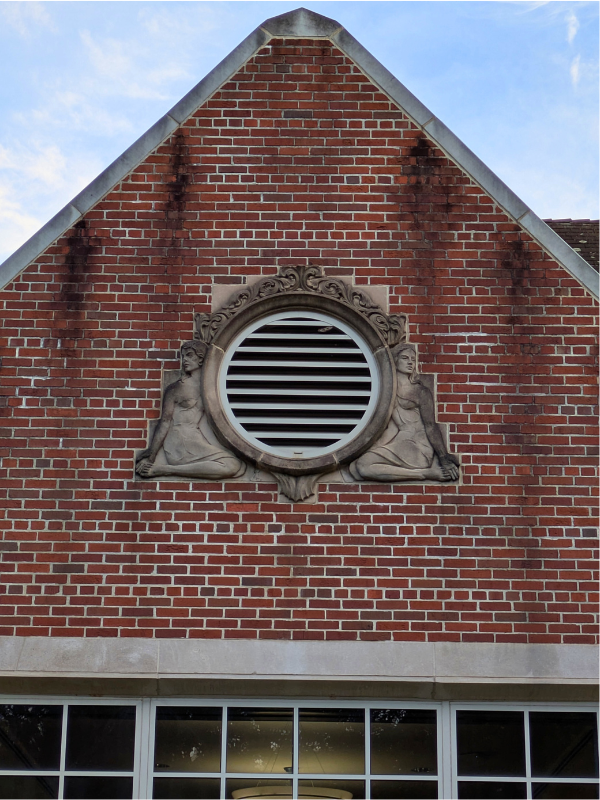
What really struck me were the beautiful limestone carvings found on the four wings of the Evans. After a few emails to Agnes Scott Alumni, I found no one who was familiar with or had even noticed these.

These limestone bas-relief carvings can be found on all four windows of Evans. The women appear nearly nude, with open outstretched hands. Imagine my surprise when I found information on these hidden carvings. In the Agnes Scott Alumnae Quarterly Winter 1977 article, “They Shake Our Air,” author Jeanne Osborne Gibbs ‘42 wrote an excellent article on all of the symbols found on campus, including these women.
Fritz Paul Zimmer, a sculptor, made many of the carvings found on Evans and three other buildings at Agnes Scott. Born in Germany (in an actual castle!), he immigrated to the United States in 1928 after an accomplished early career in his homeland. In 1930, he became Professor of Fine and Applied Arts at Oglethorpe University. During his long career, he sculpted hundreds of works, many of which can be seen throughout Atlanta and Decatur.

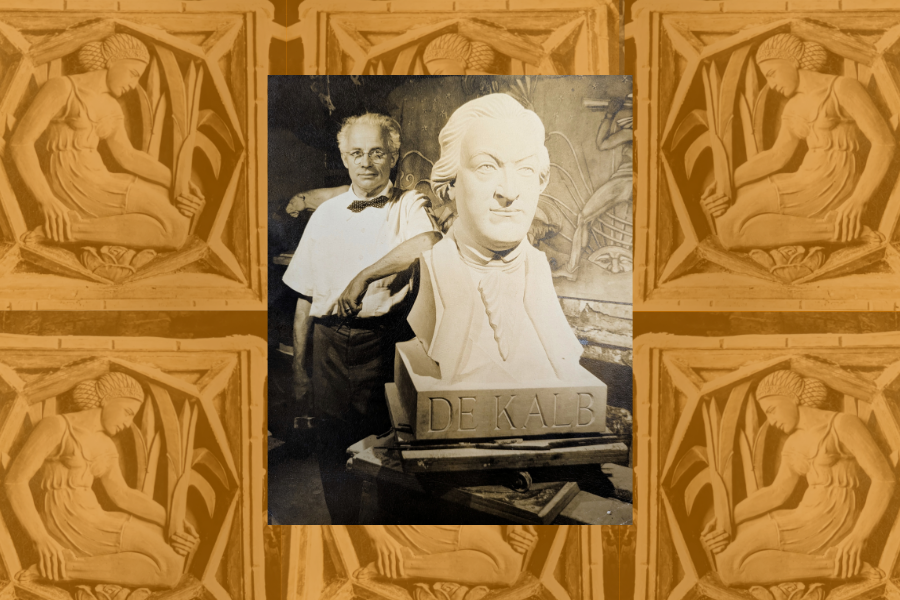
Zimmer is next to his 1948 carving of Baron De Kalb. The bust was placed at the entrance of the DeKalb Building until the building was demolished in 1975. After several years of being missing, the bust was rededicated on Decatur Square. Fritz Zimmer Collection, Oglethorpe Archives.
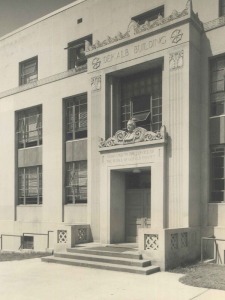
The DeKalb bust at the entrance of the DeKalb Building, Decatur. The 1948 DeKalb Building was designed by the firm Sayward, Logan & Williams, another connection between Zimmer and Logan & Williams. Benzur Collection, DeKalb History Center Archives.
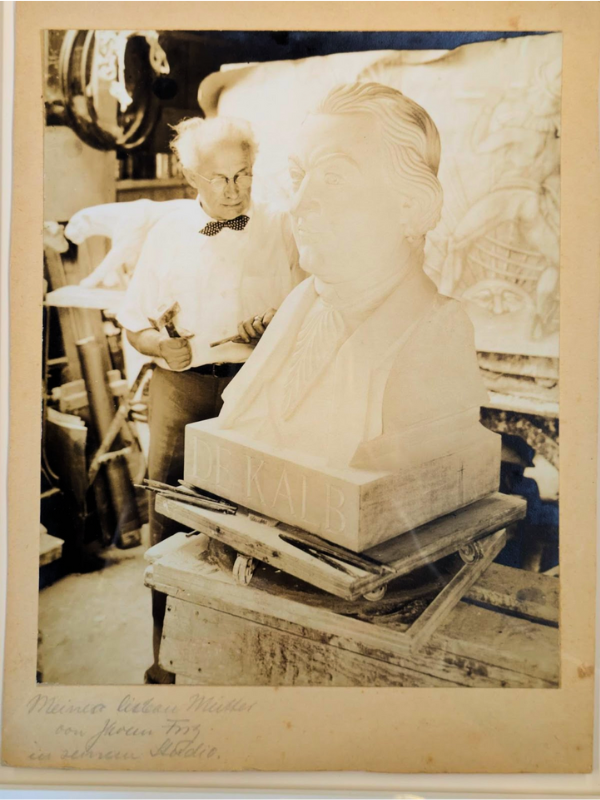
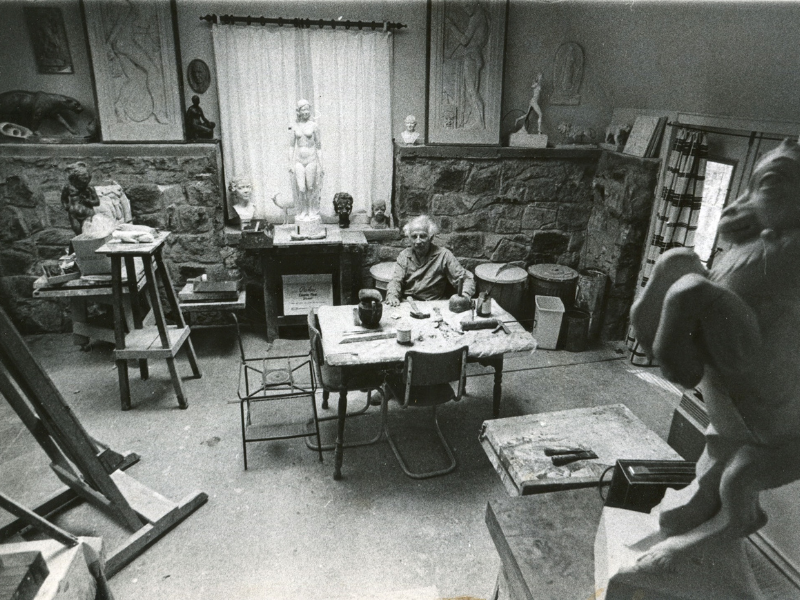
Zimmer used sharp-edged tools to shape the features of his busts. More minor details in the plaster were defined using rasps and files to be more precise when creating facial features, eye creases, and brows. Once the plaster sculpture had taken shape, he would complete any final details in front of the patron, frequently in front of a crowd on stage.
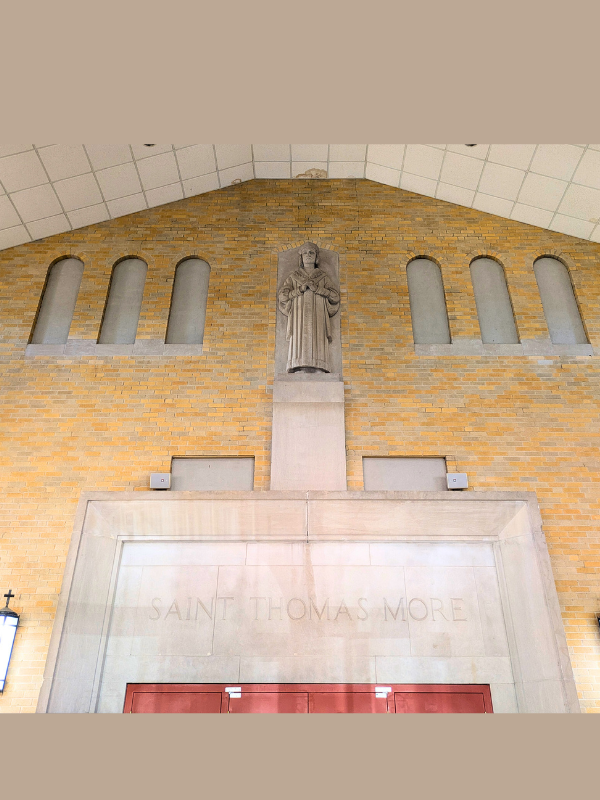
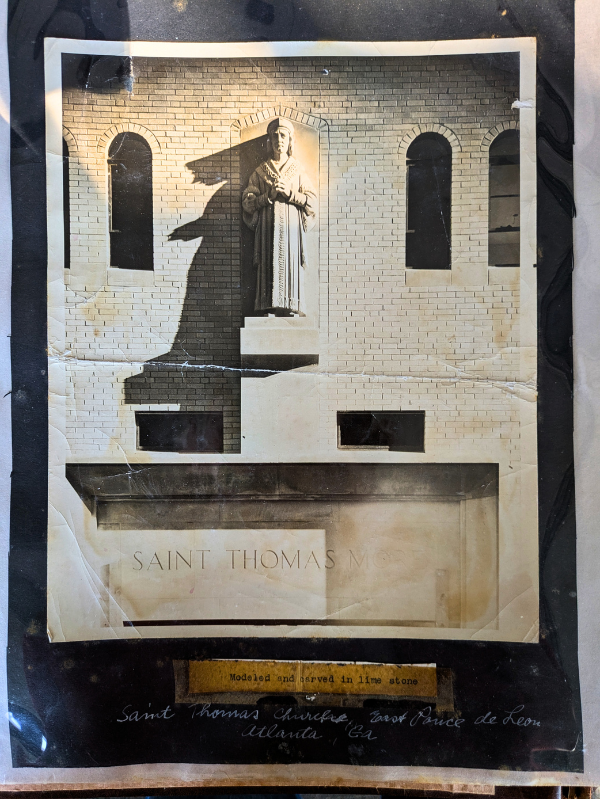
His work can also be found in 60 churches, including First Baptist Church of Decatur, St. Thomas More, and one of his most significant works at Westview Cemetery.
Statue of St. Thomas More at St. Thomas More Church and School, Decatur, when completed ca.1950, and statue today, Fritz Zimmer Collection, Oglethorpe University.

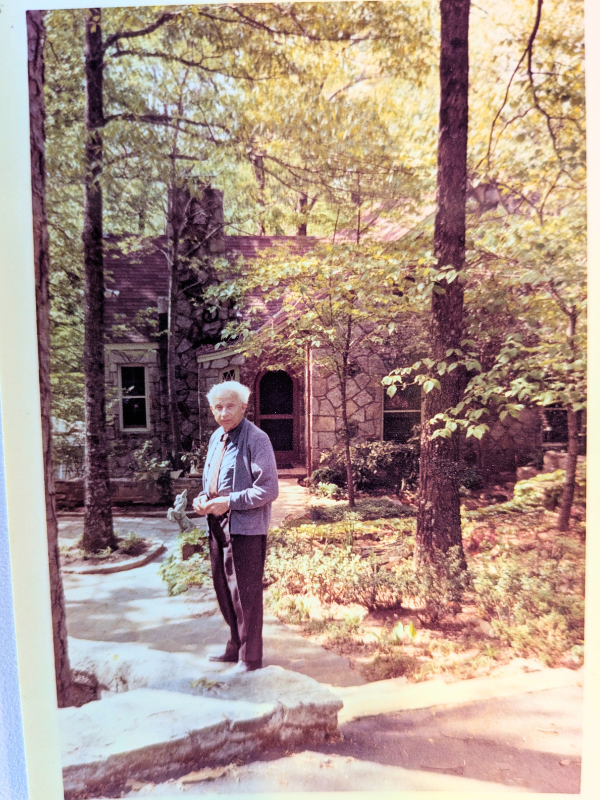
Fritz Zimmer, at his home and studio on Gatewood Drive on Emory’s Campus. Fritz Zimmer Collection, Oglethorpe University.
Back at Agnes Scott College, Robert B. Logan designed Leitia Evans Dining Hall (ca.1950) in the Gothic Revival style and created many of the insignia in Gothic style. Morris A. Hall, another architect with the firm of Logan & Williams, drew working drawings from which Zimmer made his clay models. These clay models were then sent to stonemasons in Indiana, who carved them from limestone into the final product. According to the 1977 Agnes Scott article, Logan designed the women surrounding the windows. According to Mrs. Logan, instead of gargoyles, Logan designed women, thinking the human body the supreme work of art. He [Logan] had designed the women sitting-kneeling around the four round windows to be nude from the waist up. “When Dr. McCain [President of Agnes Scott College] saw that, he ordered clothes to be put on those girls at once,” recalls Mrs. Logan.
However, in an Atlanta Journal-Constitution Magazine article from 1973, it was Zimmer who designed the nude women. Zimmer recalls the incident with Dr. McCain, to the magazine.
(The following was written verbatim in the magazine.)
“The Architect [Logan], he put round windows in it. He says, ‘can you not make something for them? I said “Oh, yes.” and I did cast two stone girls for every window. When the stones were ready, I bring them out there and lay them on the lawn. “The president came by and said, ‘Mr Zimmer, what is that here? They are nude. You cannot have anything so.’ I say, ‘Doctor, that is not nude! They have nylon nightshirts on.’ We kept talking and he said, ‘All right, I will let you do it, I think. They do have on the nylon nightshirt.”
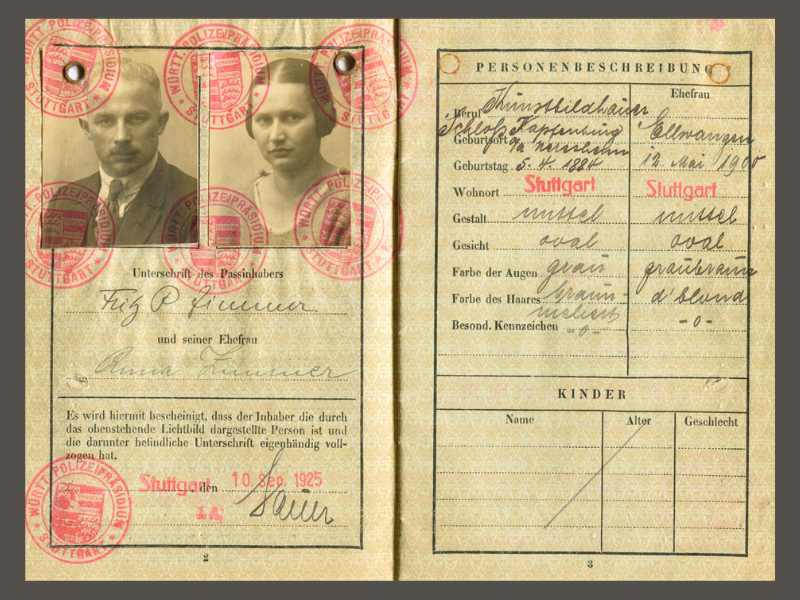
These competing accounts are interesting. Carved nude women on a building named after a woman, Letitia Pate Evans, the financier of the building (who was still alive at the time) is a good enough reason for the competing accounts. My inclination is that it was Fritz P. Zimmer who made these sculptures, not Logan. However, it would not be uncommon for architects to sketch the ornamentation for their buildings. Looking at his body of work, the similarity between the figures at Agnes Scott College and his other work is uncanny. For one, his wife, Anna Schnitzer Zimmer, was his model for many figures, and looking at her image, you can see the similarities.
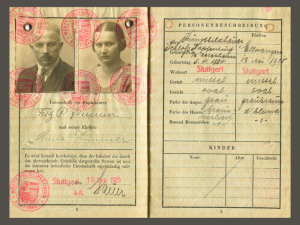
The passport of Fritz and Anna Schnitzer Zimmer. Anna was first his modeling student and later his second wife. Fritz Zimmer Collection, Oglethorpe Archives.
The women of Evans have distinctive features, seen also in Anna—strong brows, a cold gaze, an intense nose, and a soft, feminine mouth with a cupid’s bow.
The women of Agnes Scott are also very similar to Zimmer’s work on Valdosta’s University- the carvings seen below.
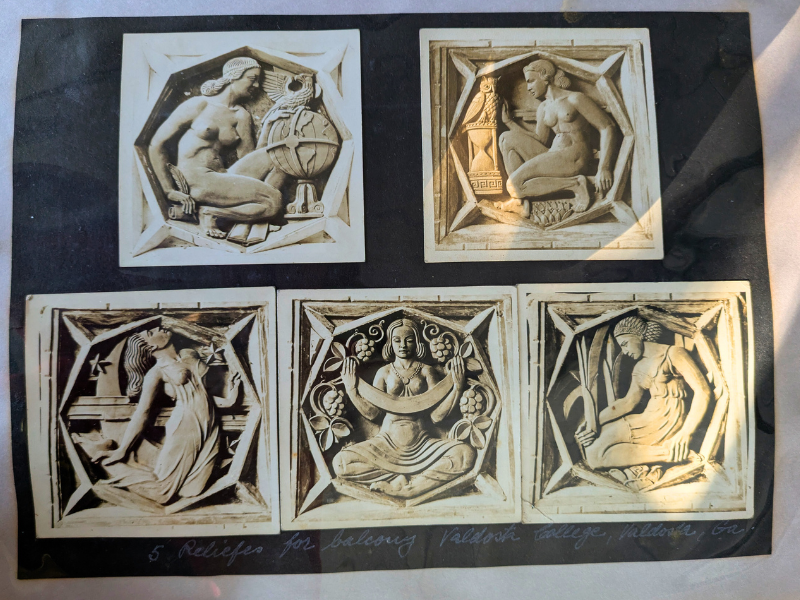
Carvings for the exterior balcony of Powell Hall, Valdosta State University. Completed in 1940, carvings still exist. Fritz Zimmer Collection, Oglethorpe University.
The relief work of the women of Evans is also very similar to his carving at Westview Cemetery.

Fritz Zimmer next to his bas-relief work, “The Last Supper.” Commissioned by Asa Candler, it was sculpted in 1950 and is part of the “Fountain of Life” Memorial at Westview Cemetery. You can still see it today. Fritz Zimmer Collection, Oglethorpe Archives.
Notice the way the figures’ heads are depicted versus the arms and hands. Carving hands in 2-D would be incredibly tricky, and so the hands are boxy and flatter than the heads. The Last Supper relief bears a resemblance to the appearance of the Evans women. Whether the idea first came from Logan or they came from Logan’s design or Zimmer’s hand, they feel unmistakably Zimmers—strong, expressive, and human in a way that connects back to Anna, his wife of 50 years.
During the tour of Agnes Scott’s campus, where I first noticed these sculptures, I had no idea the story I would discover about a German-born artist in DeKalb. Bombing in Germany during World War II destroyed many of Fritz Zimmer’s early works in Germany, but we have numerous examples hidden in parks, churches, and schools in DeKalb County. The women of Evans have quietly kept guard over the students at Agnes Scott for 75 years. I encourage you, next time you are out, to slow down and see if you can spot hidden art that dots the landscape.
Other Fritz Zimmer sculptures you can still see today:
- Bronze Deer (Reh) situated in the Southern Seasons Garden at the Atlanta Botanical Garden, 1923.
- First Baptist Church of Decatur
- First Baptist Church of Atlanta
- Church at Wieuca
- Jewish Temple of Atlanta
To learn more:
Fritz Paul Zimmer, 50th Anniversary Exhibition