Farmers Markets of Atlanta and Decatur

A brief history of Farmers Markets in Atlanta and Decatur
By Marissa Howard, Programs and Membership Coordinator
Have you been to the Atlanta State Produce Terminal / Atlanta State Market in Forest Park?
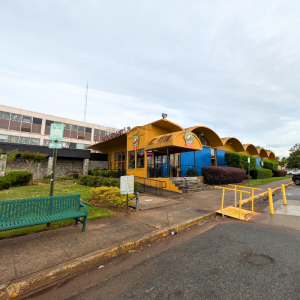
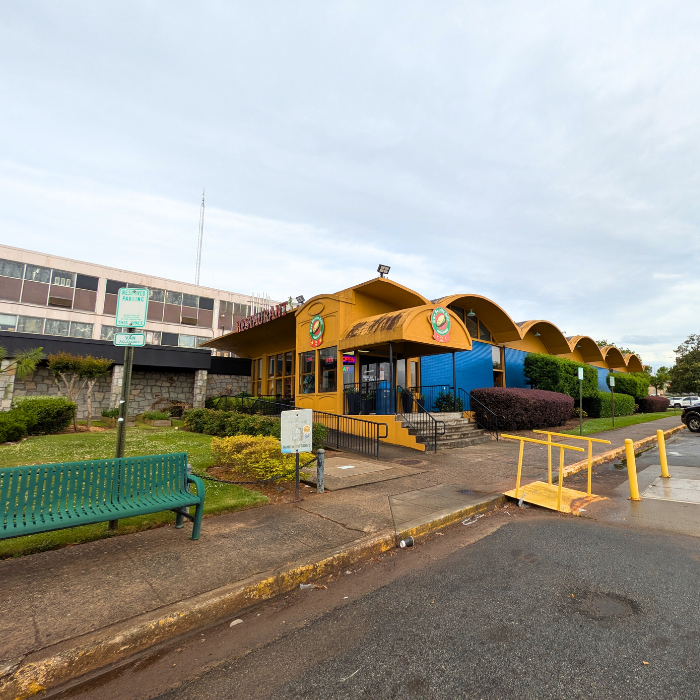
Restaurant at the Atlanta State Produce Terminal/Atlanta State Market in Forest Park.
This public market has been operating since 1959. On a whim this past weekend, we decided to check it out. But first, a quick history of municipal markets.
People need to eat, and people need to shop. Until about 1916, there were no public municipal markets in the metro area. Prior to that point, produce was purchased at informal curb markets (populated by pushcarts or sidewalk vendors) or small grocery stores.
The main concerns with these informal markets were the lack of sanitation, the quality of products, and the exposure to the elements.
1914 – Kamper’s Grocery opened in downtown Atlanta and became the forerunner to the modern supermarket. It was not a corner grocery store nor a curb market but a multi-department market that offered meat, produce, and goods in a clean environment. The items were more expensive than what was sold at curb markets.
Local groups began advocating for a municipal market that could control prices and food safety.
1917 – One of the first public municipally sanctioned markets opened in Decatur on the courthouse square. Open on Tuesdays and Saturdays, this market sold a wide range of products, including live chickens, eggs, canned goods, and pedigreed dogs. On opening day, vendors sold $1,000 worth of goods.
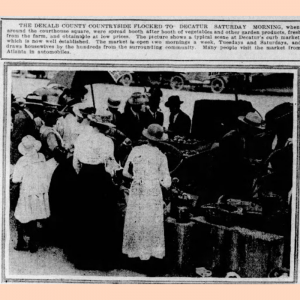
DeKalb Farmers Market, Decatur. Atlanta Journal, July 14, 1917.
1929 – Decatur City Council needed to find a new location for a market as they reversed course and created an ordinance against trading and peddling around the courthouse square. A new Decatur Municipal Market opened on Maple and McDonough Street. Not much is known about this market.
1924 – The Atlanta Municipal Market (now known as the Sweet Auburn Curb Market) was built as the city’s first public market. In its heyday, the Atlanta Municipal Market was the largest food and retail center in the state, serving 25,000 to 30,000 customers per week. This indoor market continued to grow, but pushed out the smaller independent farmers who sold their own product. This market is still in operation.
Herbert Turner Jenkins, Atlanta’s longest-serving police chief, remembers when he grew up on a farm near Lithonia and would bring surplus produce to curb markets in Atlanta.
“From 1916 – 1924, my family lived on a hundred-acre farm near Lithonia. One year, we had a good group with a surplus, and we loaded the vegetables into our Dodge touring car and arrived at a curb market in Atlanta. During Christmas, we would gather mistletoe and sell greenery from our Dodge.” (Edited for clarity)
1936 – A new State sponsored market known as the Atlanta Farmers Market opened just a few blocks away, offering customers a more open-air experience. This market was more of an overflow market for the Atlanta Municipal Market. It was located at the corner of Courtland and Gilmer Street – now the location of the GSU Student Center. According to some accounts, despite being new, it lacked modern facilities that made it a pleasant shopping experience and quickly went downhill.
These markets were important for DeKalb County and its plentiful farms and dairies.
1938 – The Georgia Department of Agriculture sought a larger space and found it south of downtown on Murphy Avenue and Sylvan Road in Southwest Atlanta. The new Atlanta/Georgia State Farmers Market opened in 1941 and featured six produce buildings, which offered 117 stalls. These open-air concrete sheds provided cover from the elements. This new market shifted consumers from a pedestrian-centric model to driving; they browsed from their cars. Imagine the chaos of this market. Space in the market would accommodate up to 600 trucks during peak season. This market was conveniently situated on a train line, with a spur that led directly into the market for easy transportation of goods.
These buildings still exist, for the most part, and are located on the Southside Beltline with the goal of redevelopment.
1945 – The Atlanta State Farmers Market was already running out of space and looking to expand. The Georgia Department of Agriculture inspected the Atlanta Municipal Market and the Atlanta State Farmers Market and deemed they were all out of space.
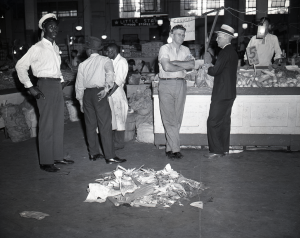
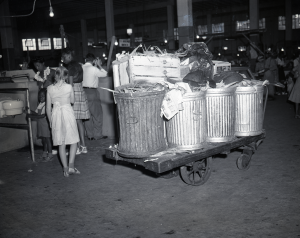
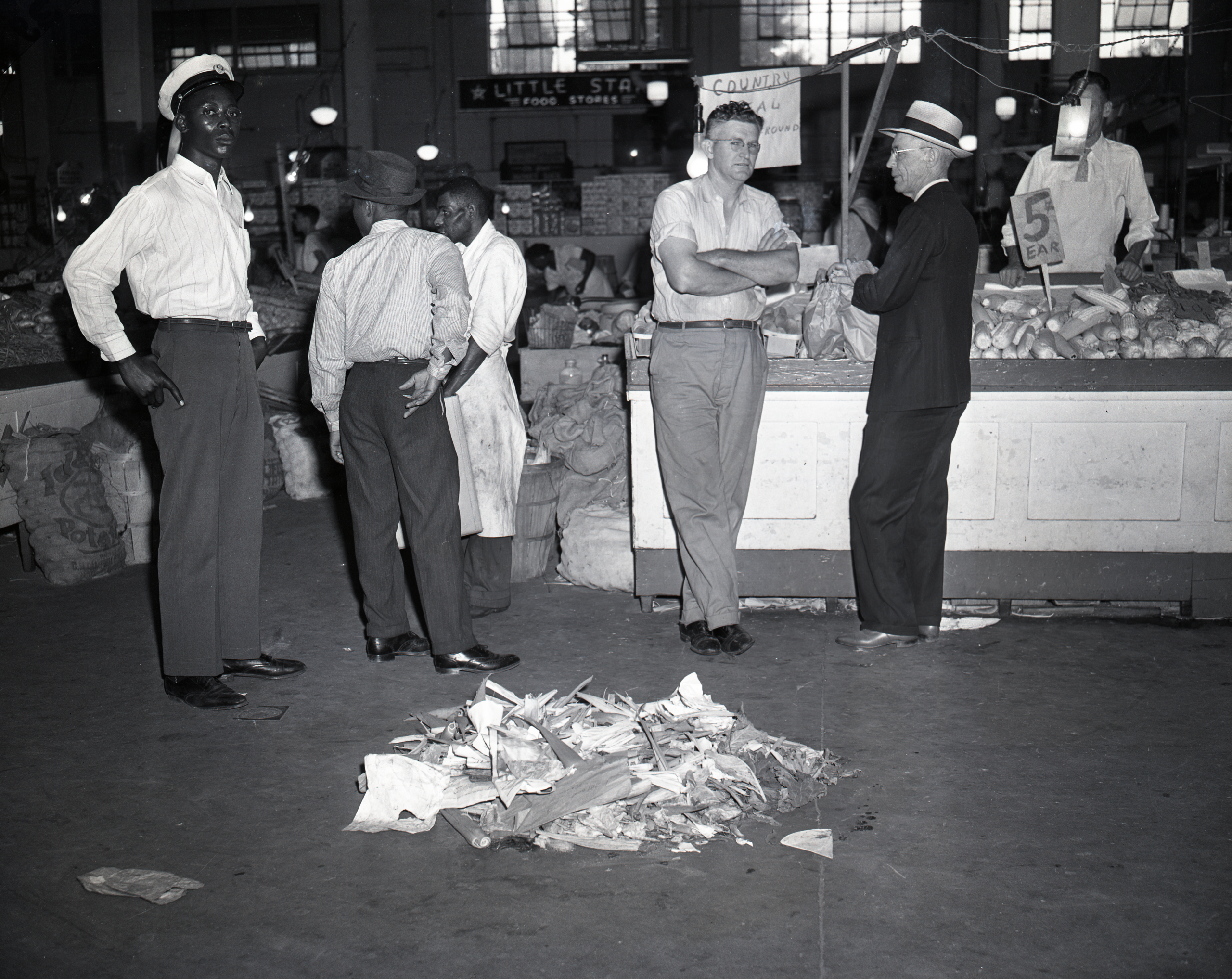
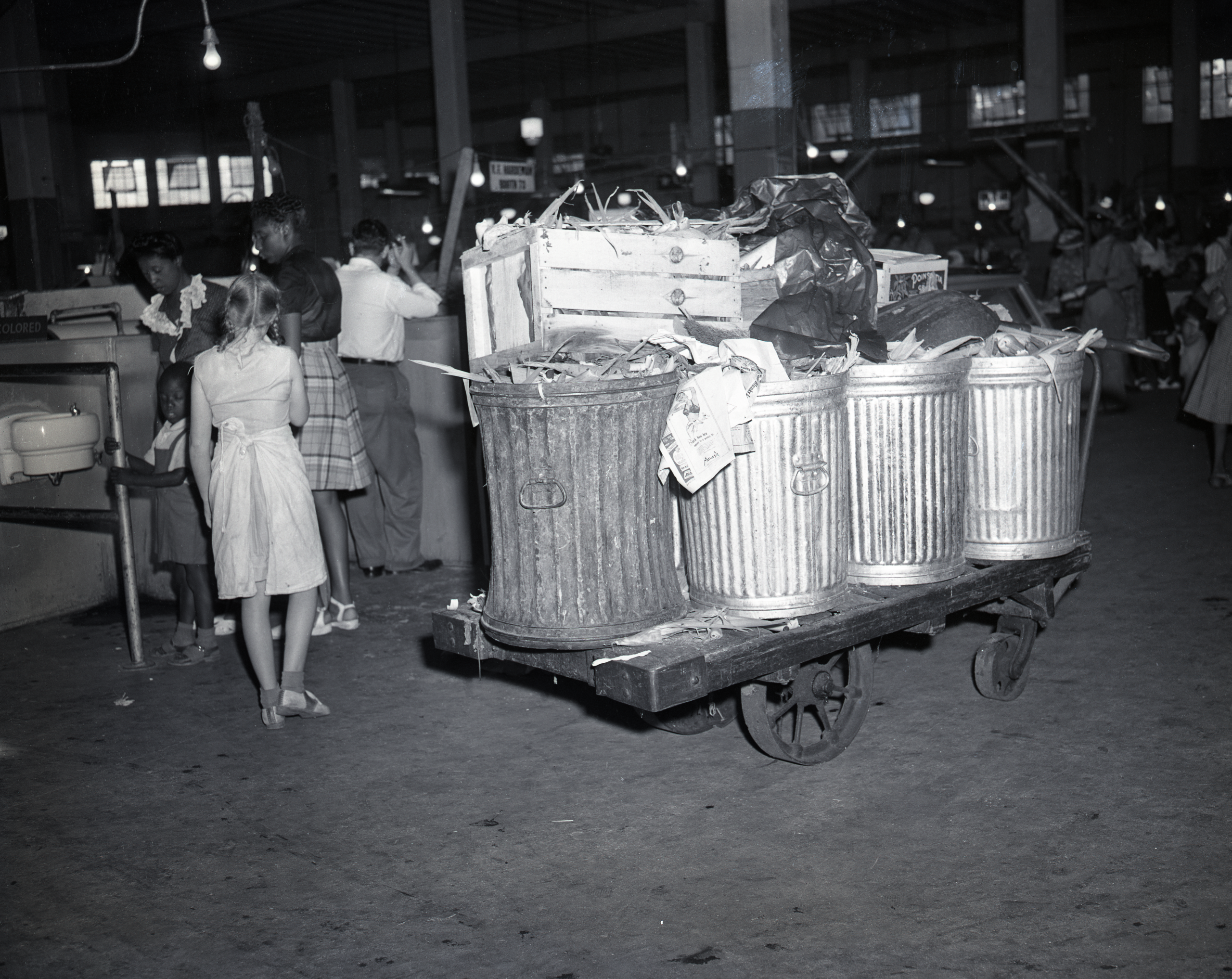
Inside Atlanta Municipal Market (Sweet Auburn Curb Market) ca. 1946. This series of photos shows the condition of the market. We are able to date this photo by looking at the discarded newspaper. Guy Hayes Collection, DeKalb History Center.
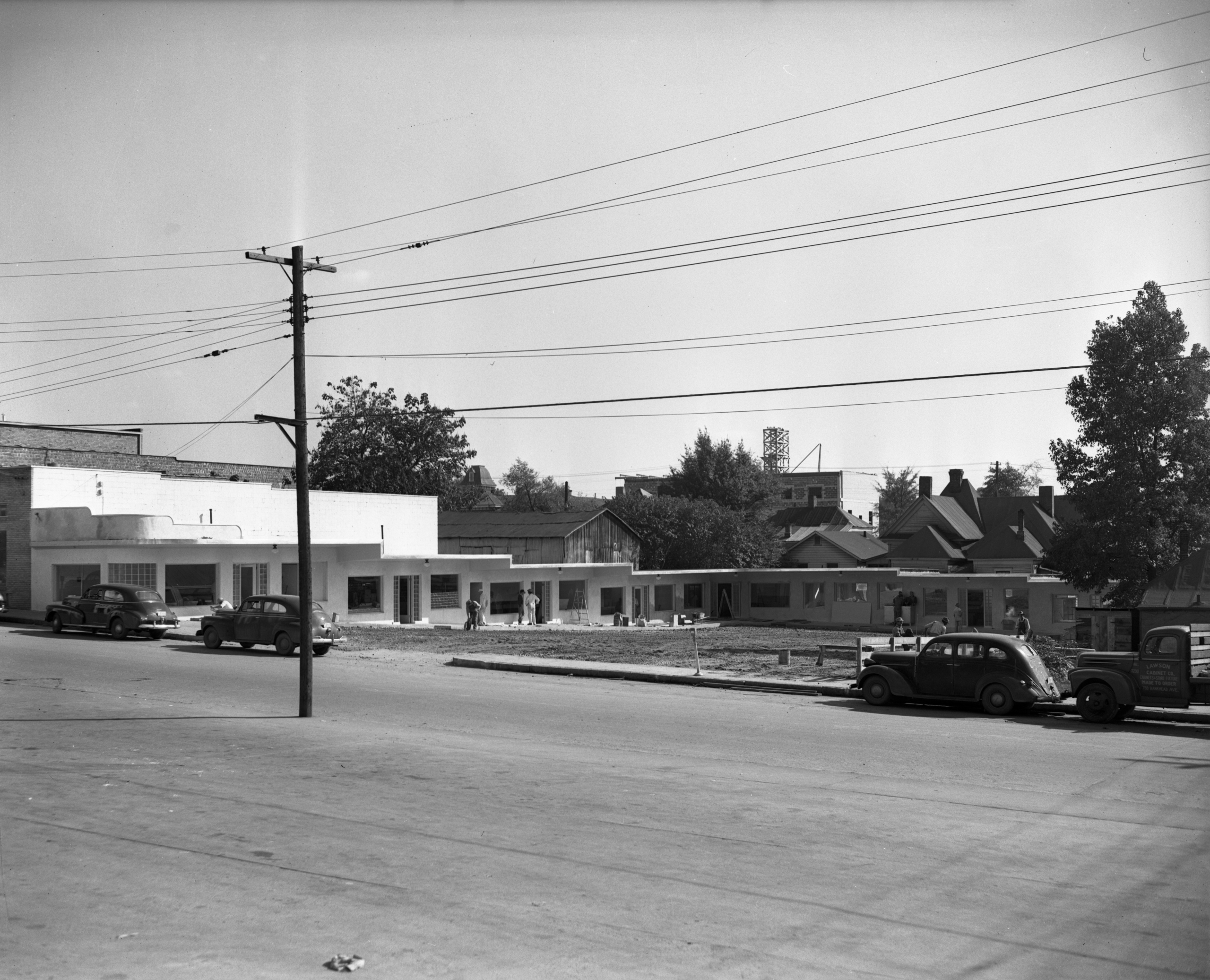
1947- DeKalb Farmers Market opens in Decatur on Atlanta Avenue, one block from the Courthouse. Cost $50,000 and was a “California Type” with an open court for 42 autos, developed by Guy Rutland, Jr. The market was home to just a few shops, including Graddy’s Grocery and DeKalb Poultry and Egg, but by 1960 it was a parking lot. It became the site of the new DeKalb Courthouse in 1967.
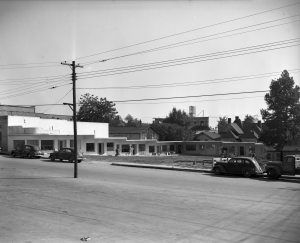
DeKalb Farmers Market under construction in Decatur, 1947. Guy Hayes Collection, DeKalb History Center.
1956 – The State of Georgia purchased a 140-acre site off I-75 in Forest Park.
1959 – The new Atlanta/Georgia State Farmers Market opened in 1959. Occupying 146 acres, it was built for $10,000,000. At the time, it was considered the world’s largest market.
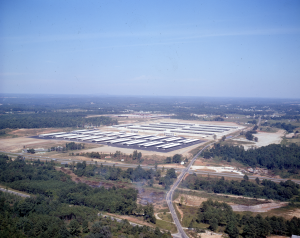
In this image, we see the newly constructed Atlanta State Farmers Market. In the middle of the photo, running from left to right, is I-75, a two-lane road at the time. You can see clearcutting and the beginning construction of the exit ramp at the bottom right. Photo, ca. 1959, Guy Hayes Collection, DeKalb History Center.
The market was home to a Davis Brothers Cafeteria, ca.1960, that was once open 24 hours a day. It closed around 1995. Today, it is Don Burrito Grill (shown below). The ceiling features a striking mural of Atlanta, likely painted when the space was the Oakwood Café. Windows would have originally been in all of the curved bays of the roof.
Today, the market stalls predominantly serve the Latino community. It’s a fun experience that transports you out of Atlanta. When we visited earlier this month, we browsed the stalls while sipping on a freshly opened coconut and watching vendors clean nopales leaves.
Most of the information in this article is from the book Food, Fairs, and Farmers’ Markets in Atlanta by Herbert T. Jenkins. Additionally, the Randy Cox Collection and Oral History at the DeKalb History Center is an additional resource to learn more about the Atlanta State Farmers Market.
We hope you enjoyed a peek into the hidden gems in our Archives. Please consider making a financial contribution to support the Archives.