Stories from the Archives Stacks

Read on as we unearth some hidden gems within our Archives. These pieces were originally featured in our Fall 2025 Quarterly Journal. Please consider supporting the DHC Archives by donating here.
Archives are at the heart of our mission. They provide endless histories, stories, and glimpses into our past. Archives encompass a wide range of items, but generally they are documents. This can include things like scrapbooks, images, audio recordings, paper documents and newspapers. For our final Quarterly Journal of 2025, we wanted to open the vaults and highlight a few archival collections and items we find fascinating. Some of these collections have never been shared publicly before.
Would you like to donate something? You can always reach out to us. Unfortunately, we can’t always take everything, but donating your items to an institution like ours is a way to preserve it for future generations and give others the opportunity to see your story!
We can’t highlight every collection in this edition but please read on to learn about a few of the rich resources you can find digging through the stacks here at the DeKalb History Center.

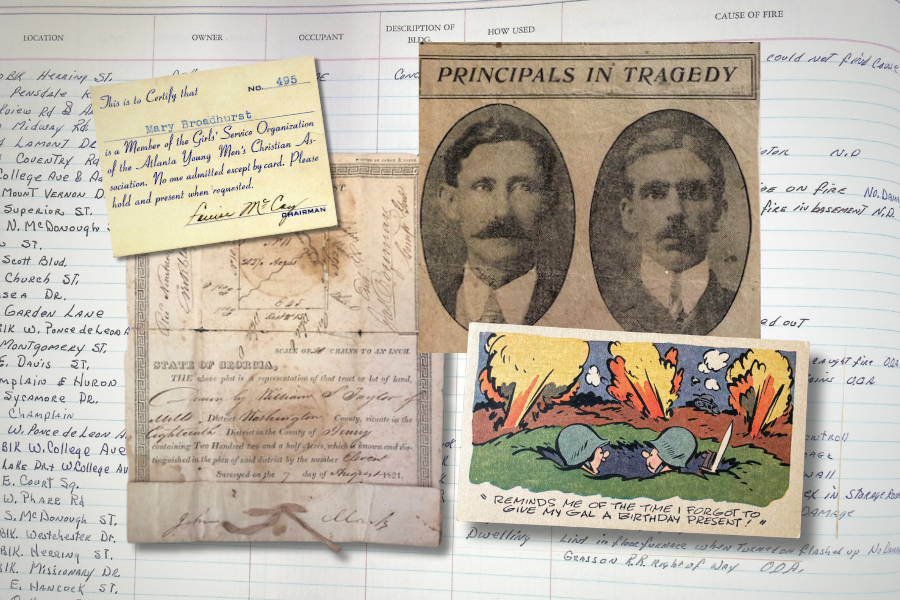
Deed from the original Georgia land lottery of 1821. This is the oldest item in our archives.
Family Time and True Crime
By Jennifer Blomqvist, Archivist & Volunteer Coordinator
We have collections in the Archives that I call family collections. These are groups of items relating to a particular family or a blended family in DeKalb. Materials generally include scrapbooks, journals, letters, newspaper articles, photos, and more. I reviewed one such blended family collection recently; someone had made a note that medical records were part of the collection. I was intrigued. It turned out to be a misprint, but the collection is interesting in any event.
The Broadhurst-Philips Collection is a group of items related to a blended family – the Broadhursts from Fitzgerald, Georgia, and the Phillips from Oakhurst/Decatur, Georgia. Dr. John Halsey Phillips was a doctor in the Atlanta area for many years. He was also a councilman and tax assessor for Decatur and the first mayor of Oakhurst, according to his obituary. He died in 1932 from complications following a medical procedure. William Gibson Broadhurst was a prominent businessman in Fitzgerald. An article in one of the scrapbooks reads “Public Wants Syrup in Smaller Packages.” As Broadhurst was a syrup manufacturer, he gave the public what they wanted and added smaller bottles priced at 10-15 cents as a supplement to the standard gallon size. He passed away in 1930.
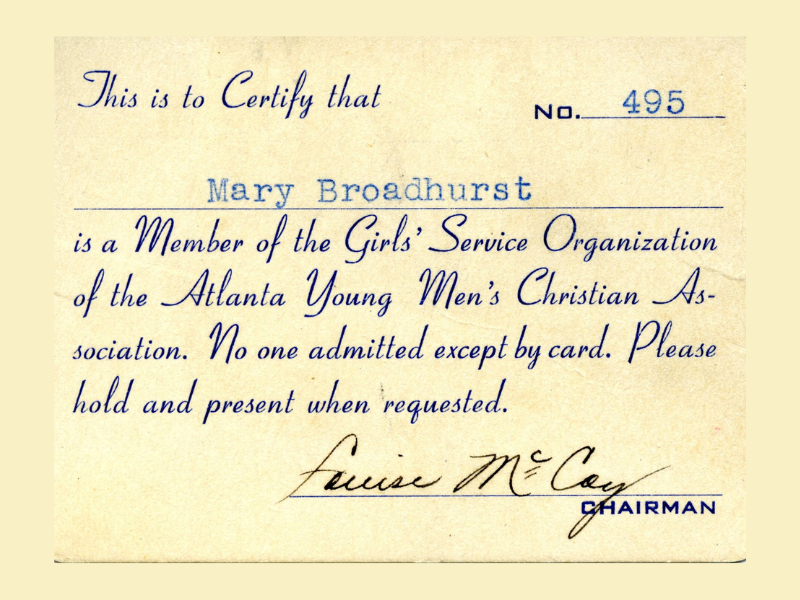
Children from these two families – Emma Mary Phillips and William Gibson Broadhurst, Jr. – were married. Emma was a student of the Leffingwell Violin School and a member of the Atlanta Ladies’ Concert Orchestra. She was a socialite who also served in the Girls’ Service Organization, which was part of the Atlanta YMCA. She even procured an invitation to see the White House in 1935. There are several scrapbooks, compiled by Emma, that are part of the collection, as well as family photos, letters, and journals.

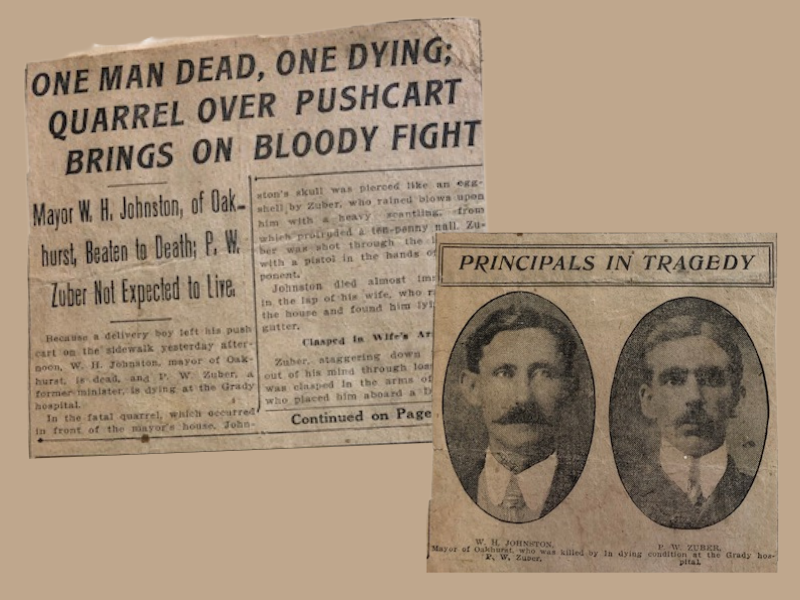
What I hadn’t expected to find while looking through all of the family memorabilia and social news was a group of articles about a horrific incident in Oakhurst on September 24, 1911. The headline reads “One Man Dead, One Dying: Quarrel Over Pushcart Brings On Bloody Fight.” There was an incident between the Mayor of Oakhurst at the time, W. H. Johnston, and a grocer, P. W. Zuber, who had left a grocery cart in the street outside of Johnston’s home in Oakhurst. When the cart wasn’t moved in a timely fashion, Johnston kicked it and spilled all of the contents onto the ground. A fight ensued and Johnston was killed. Zuber was shot and managed to make it to a nearby hospital. I suppose the story hit close to home for Emma and she decided to preserve it in one of her scrapbooks.
You never know what you might find in our Archives. Thank you for considering helping us to continue to collect, preserve, and share these interesting finds.
Miscellaneous Treasures
By Rebecca Selem, Exhibits & Communications Coordinator
We at the DeKalb History Center have been collecting archives and artifacts from our community since 1947. Naturally, collecting procedures back then were not as advanced as they are presently, leaving a number of collections a mystery in terms of where they came from or who had owned them. These collections are housed in manila folders in “miscellaneous” boxes.
Personally, I find these mysterious archival collections to be the most fascinating. Thumbing through correspondences from unknown people who lived decades ago or sorting through photographs of people who may be forgotten to history is enjoyable, as they lay unclaimed in shell boxes nestled within our walls.
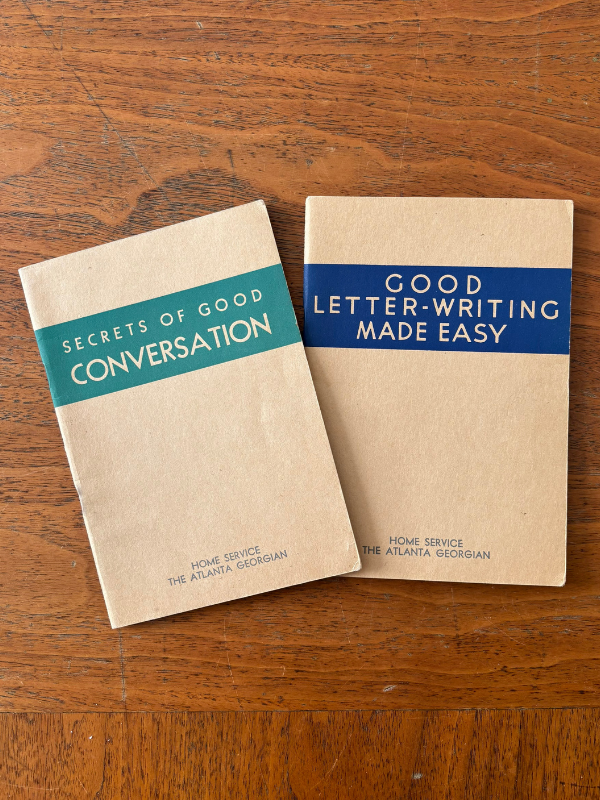
Recently I dove into a miscellaneous box, eager to come across something unseen and full of mysteries. Two booklets, Secrets of Good Conversation and Good Letter-Writing Made Easy were first to pique my interest. Inside, the booklets feature helpful tips on each topic, for example the importance of speaking in a pleasant voice, avoiding pretentiousness, and how to differentiate ‘thank you’ letters versus congratulatory letters. In the back of the booklet there is a list of all the booklets offered through the Home Service Department back in 1937 including Self-Introduction to Ballroom Dancing, How to Win and Hold Love, and Overcoming “Nerves” and Every-Day Health Problems.
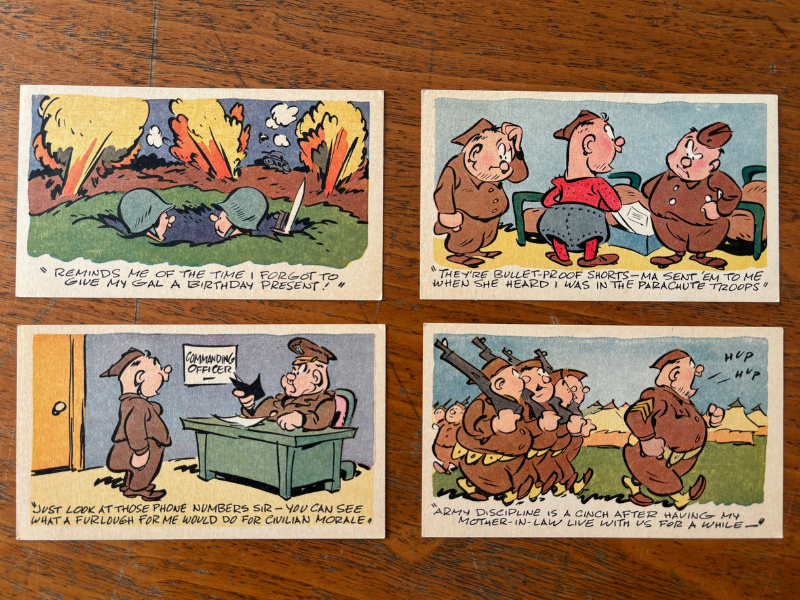
Next was the Servicemen’s Kard Kit from 1943-1945 featuring comical postcards that servicemen could easily mail to their loved ones. The kit in our collection has only unused postcards, but I imagine the person who owned it sent a few home before the war’s end on September 2, 1945.

Fire Ledger Record Books—Decatur Fire Department
By Marissa Howard, Programs & Membership Coordinator
Some of the most captivating items in our Archives are two Fire Ledger Books for the Decatur Fire Department, spanning 1949-1981. The logs include the type and location of the call, details, and the amount of damage, if any.
These entries provide an interesting snapshot of the types of calls that were made to the fire department. Early entries are filled with calls for faulty cars, mattresses on fire, trash, and brush fires. By the mid- to late-1970s, in the second book, the majority of calls were medical emergencies, including chest pain, diabetes, and other medical conditions.
Some entries are difficult to read because the subject matter documented tragedies, including calls about people found deceased or others who were injured.
There are also some humorous calls, like:
- “Husband Drunk, set mattress on fire” Hunters Alley, January 13, 1952
- “Received call to get drunk man out of tree” Decatur Depot, September 6, 1953
- “Put police on the roof of the jail to check for escaped prisoners.” April 22, 1972
These calls offer firsthand accounts of historical events:
- Decatur City Fire Department aided in a call for a B-47 that crash landed at Naval Air Station Atlanta on October 14, 1955.
- A Winnona Park Elementary School fire in 1975.
- The fire that destroyed Thankful Baptist Church in Decatur’s Beacon Hill Neighborhood in 1970. The ledger states the cause was “unknown,” although investigators suspected it was arson.
In 1972, Thankful Baptist moved to a new sanctuary on College Avenue and there was another incident at the church that year. The ledger states that someone threw cherry bomb fireworks into one of the windows of the Thankful Baptist Day Care Center. The call was reported months later, and nothing was mentioned or recorded in the newspapers at the time.
These ledger books are an amazing resource for research in our Archives, because they provide us with a first hand account of events, as they happened.

Page 32 of the City of Decatur Fire Records Ledger,1949 to 1976.
Preserving the Story of the DeKalb History Center
By Dave Stanhope, Board Member & Volunteer
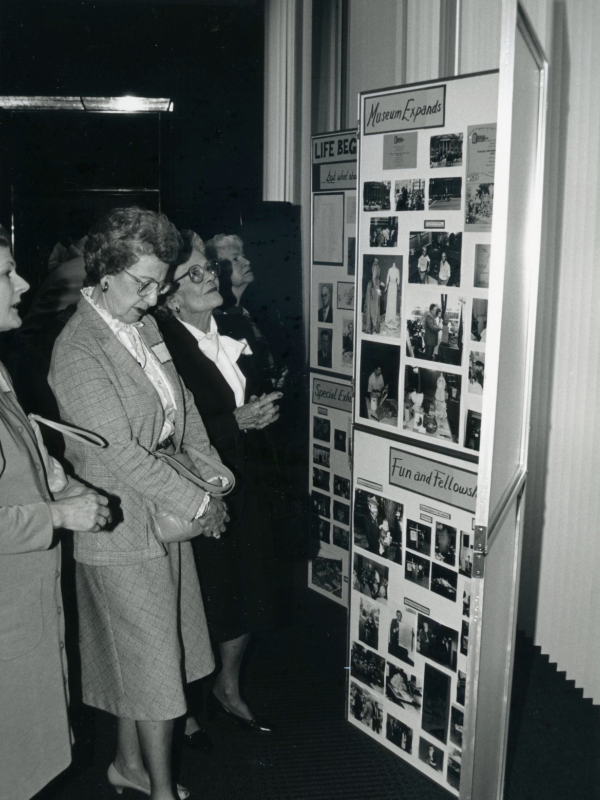
Every institution has a story, and sometimes the best stories are found not in exhibits or photographs on the wall, but in the boxes of papers stored behind the scenes. For me that’s exactly where the real adventure begins. Since joining the Archives team, I have enjoyed the countless hours processing many of the Center’s various historical collections. However, the collection that gave me the most fun and consternation was the DeKalb History Center’s (formerly the DeKalb Historical Society) institutional files, consisting of materials that document the organization’s history, growth, and community impact.
When I began working on the Center’s archives, the project seemed simple enough: about nine boxes of administrative and financial files. But as we dug deeper, the collection started to take on a life of its own. To my surprise more boxes emerged from storage closets, filing cabinets, and tucked-away corners of the archives—each filled with correspondence, photographs, exhibit plans, and artifacts that traced the Center’s journey from its early days in the historic courthouse. The expanding project became not only an exercise in archival management but also a deep dive into DeKalb County’s collective memory. What started as a small task became a growing, decades-spanning record of community partnerships, education programs, preservation projects, and local celebrations.
Now that the institutional records are fully processed, researchers and staff can easily access decades of organizational history. The collection offers valuable insight into how the Center has evolved and grown over time. It’s rewarding to know that these materials – many of which might have been forgotten – are now preserved for future generations. Like the DeKalb History Center, I am dedicated to keeping history alive and that the story of history itself begins with those who take the time to preserve it.
We hope you enjoyed a peek into the hidden gems in our Archives. Please consider making a financial contribution to support the Archives.